
Why Managers Make or Break Employee Experience

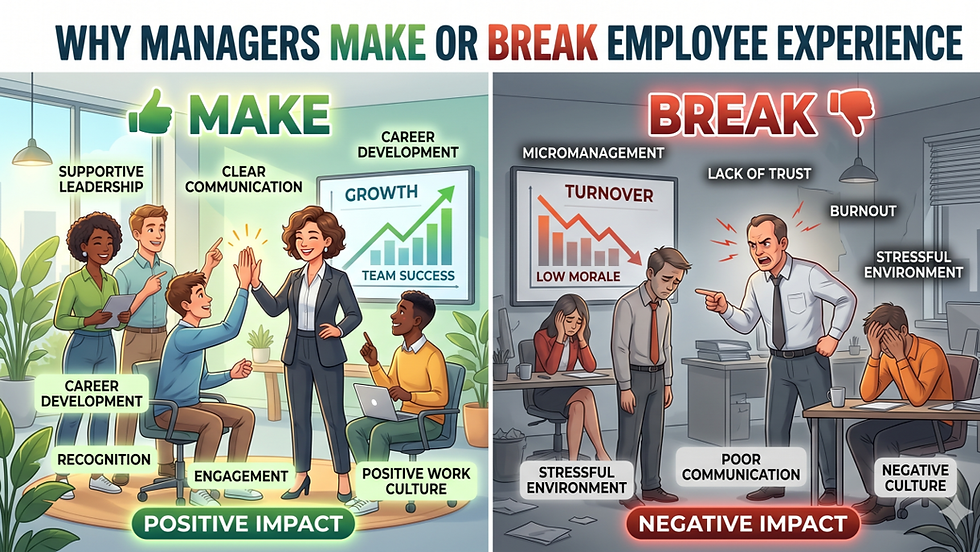
Why Managers Make or Break Employee Experience
Riya still remembers her first day—the nervous excitement, the silent promise she made to herself: “This is where I’ll grow.”
Six months later, she sat at the same desk, staring at the same screen… but something had changed. Not the company. Not the role. Not even the workload.
Just one thing: her manager.
And that one change was enough to make her question everything.
The Story We Don’t Talk About Enough
Riya joined as a high-potential employee—driven, curious, and ready to contribute. Her first manager understood that energy. He gave her space to explore ideas, encouraged her to take ownership, and most importantly, trusted her.
Mistakes weren’t punished—they were discussed. Wins weren’t ignored—they were celebrated.
Work didn’t feel like a task. It felt like progress.
Then came a shift. A new manager took over.
Suddenly, autonomy turned into approval-seeking. Every small decision required validation. Feedback wasn’t developmental anymore—it felt personal. Conversations became instructions, not discussions.
Riya didn’t lose her capability. She lost her confidence.
And slowly, she began to disconnect—not just from her manager, but from her work itself.
This is not a rare story. It’s a silent pattern across workplaces.
Employee Experience: More Than Just Perks
When organizations talk about employee experience, they often highlight surface-level benefits—flexible policies, office infrastructure, engagement activities.
But real employee experience is not built in policies. It is built in daily interactions.
It lives in moments like:
How a manager responds to a mistake
How feedback is delivered
Whether an idea is encouraged or dismissed
Whether effort is noticed or ignored
These micro-moments, repeated over time, shape how employees feel.
And feelings drive behavior.
The Manager’s Invisible Power
Managers sit at the intersection of strategy and execution, but more importantly, at the intersection of organization and employee emotion.
Their influence is deeper than it appears.
1. Managers Define Clarity in Chaos
In fast-paced environments, ambiguity is common. Employees look to managers to simplify complexity. A good manager provides direction. A poor one amplifies confusion.
When expectations are unclear, employees don’t fail because of lack of skill—they fail because of lack of direction.
2. Managers Shape Psychological Safety
Psychological safety is the foundation of innovation and engagement.
Can employees ask questions without fear? Can they challenge ideas? Can they admit mistakes?
A manager who listens builds confidence. A manager who judges builds silence.
And in silent teams, growth stops.
3. Managers Control Recognition and Motivation
Recognition isn’t just about rewards—it’s about acknowledgment.
A simple “well done” at the right moment can reinforce positive behavior. Consistent ignorance can make even the most dedicated employee feel invisible.
Motivation is not always about incentives. It is often about feeling valued.
4. Managers Influence Growth and Learning
Employees don’t just work for salaries—they work for progress.
Managers who coach, mentor, and guide create a sense of future. Managers who only assign tasks create stagnation.
And when growth stops, exits begin.
The Ripple Effect of Bad Management
The impact of poor management doesn’t stay limited to one employee—it spreads.
Disengagement becomes contagious
Team morale drops collectively
Productivity declines silently
High performers start leaving first
What’s more dangerous is that these issues don’t always show up immediately in reports—but they show up in culture.
And culture, once damaged, is hard to rebuild.
Why Organizations Get It Wrong
Most organizations invest heavily in hiring top talent. But they often promote individuals into managerial roles based on performance—not people skills.
Being a great individual contributor doesn’t automatically make someone a great manager.
Management requires:
Emotional intelligence
Communication skills
Empathy
The ability to develop others
Without training and support, even well-intentioned managers can fail.
What Great Managers Do Differently
The difference between a good and bad manager is rarely about intent—it’s about awareness and action.
Great managers:
They create clarity They ensure every team member knows what success looks like.
They build trust They empower instead of controlling.
They listen deeply Not just to respond, but to understand.
They give constructive feedback Focused on growth, not criticism.
They recognize consistently Not just outcomes, but effort and improvement.
They develop people They see potential and actively nurture it.
Over time, these behaviors don’t just improve performance—they build loyalty.
The Shift That Truly Matters
If organizations genuinely want to improve employee experience, they need to shift focus:
From:
Policies → to People
Perks → to Leadership Quality
Processes → to Daily Interactions
This means:
Investing in manager training and development
Measuring how managers lead, not just what teams deliver
Encouraging feedback loops where employees can speak freely
Because culture is not created by HR documents. It is created by managers, every single day.
Final Thought
Riya eventually left the company.
Not because she didn’t love the work. Not because she didn’t believe in the organization.
But because the experience of working there had changed.
And that experience was shaped by one person.
At the end of the day, employees don’t experience companies. They experience managers.
A great manager can turn pressure into purpose. A poor manager can turn opportunity into exhaustion.
So if there’s one investment organizations cannot afford to ignore, it’s this:
Build better managers, and you build better workplaces.


Comments